

SPV Platform
Investor onboarding, accreditation, identity checks and signing in one flow, from deal setup to close.
A special purpose vehicle is a small entity with a large amount of paperwork attached. Someone structures a raise, invites investors, confirms each one may legally participate, verifies who they are, collects signatures, tracks money in, closes the vehicle, and keeps a record that still makes sense years later. This platform runs that sequence.
Sector
Private markets, syndicated investment
Built for
Organizers, investors, legal and accounting panels
Scope
Web app, REST API, assistant service
Regulatory context
Regulation D, 506(b) and 506(c)
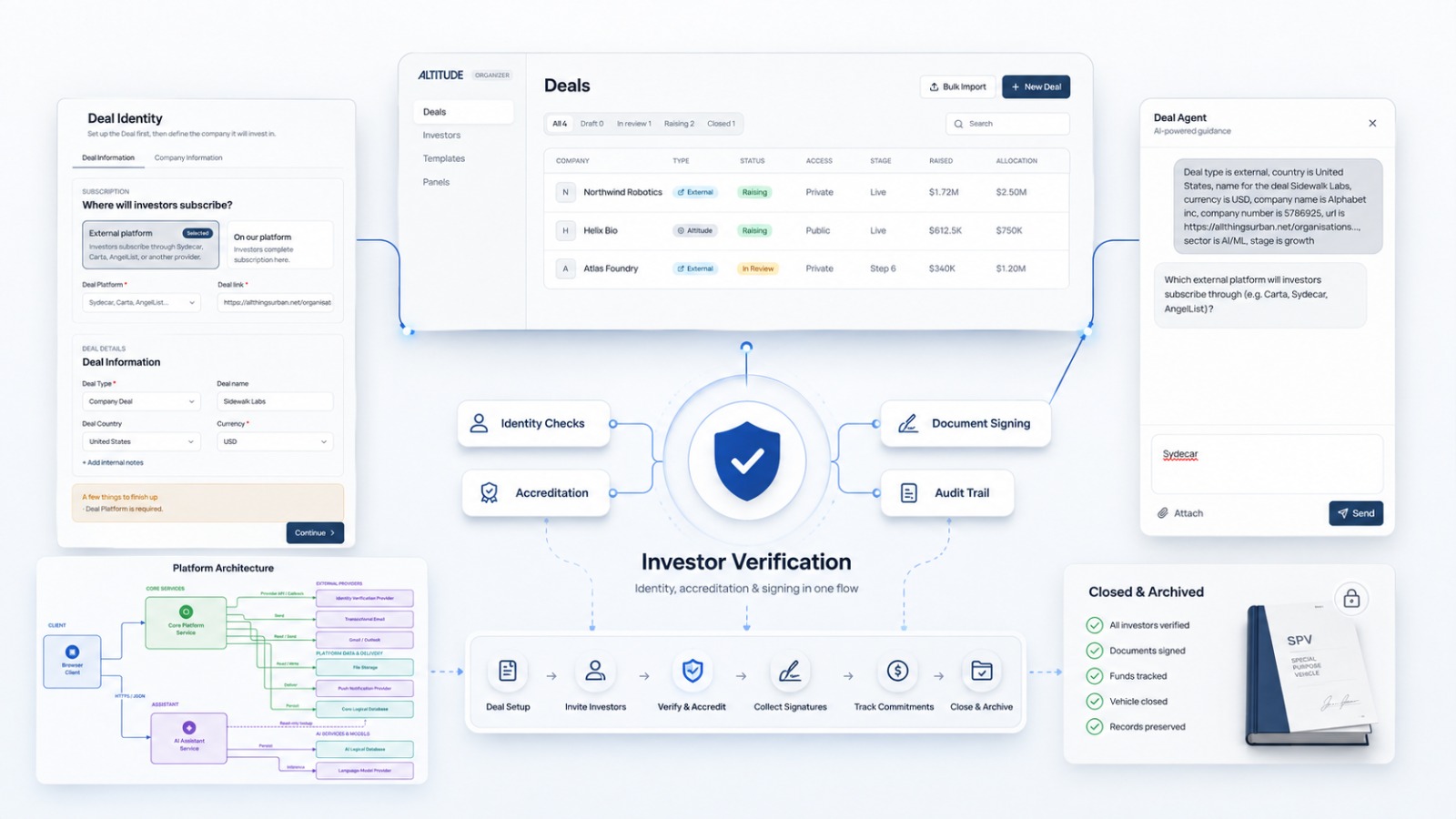
The tools work. The seams between them fail.
A spreadsheet for investors, a signature product for documents, an identity vendor with its own dashboard, an email thread for wire confirmations, and a folder of PDFs that becomes the only record. The state of the deal exists in none of them and has to be reassembled by whoever remembers where to look.
The deal is one record with an explicit lifecycle.
Accreditation, identity verification, signing and funding are stages of the same object rather than events in four separate systems. Every step writes back to it, and the close takes a snapshot of where everything stood on the day.
Seven stages of a raise.
Each one writes to the same deal record.
Deal setup
A guided sequence covering identity, economics, managers, bank account, investors, panels and documents. Autosave on a short debounce, with stale writes rejected rather than silently overwriting.
The assistant
Describe the raise in a sentence and receive a populated deal, a list of what is missing, and a question or two. It proposes, it never writes.
Accreditation
Income, net worth, role and licence paths for individuals. Asset, institution and owner paths for entities. Self attestation accepted under 506(b) and refused under 506(c).
Identity checks
A link rather than an account. Document upload, liveness check, defined session lifecycle. Verification from a prior deal within twelve months carries forward.
Documents and signing
Templates with parameter substitution or uploaded files mapped to deal values. Signing happens in a room reached by link, and the executed version is stored against deal and investor.
Money
Capital calls, payment proof, wire receipts and a reconciliation view with an exceptions list. Refunds carry their own release form and proof. Allocation changes are audited individually.
Close and after
A readiness check, a snapshot at close, a cap table export, and a closing binder merged into one PDF that names what it cannot include rather than quietly omitting it.
Accreditation is enforced, not documented.
The qualification paths exist as they actually are, rather than as a checkbox saying the investor is accredited. Status expires after five years, expiry is tracked, and reminders go out before it lapses.
Individuals
Income at two hundred thousand individually or three hundred thousand jointly across the prior two years, net worth above a million excluding primary residence, a director or executive officer role at the issuer, or an active Series 7, 65 or 82 licence.
Entities
More than five million in assets while not formed for the purpose of the investment, status as a regulated financial institution, or every equity owner qualifying independently.
The exemption matters
Under 506(b) an investor may self attest. Under 506© they must provide supporting documentation or authorise an independent verifier.
The verifier flow
A CPA, registered adviser or attorney receives a link, uploads a verification letter and submits without creating an account, because a lawyer will not sign up to spend ten minutes on it.
Describe the raise in a sentence.
Setting up an SPV for a Series A company raising five million at twenty percent carry produces a populated deal identity and economics, a list of what is still missing, and a question or two to fill the gaps. It also parses an investor list out of a spreadsheet and deduplicates by email address.
It proposes. It never writes.
Extracted fields are validated against the same schemas that validate typed input, and a proposal that fails is rejected like any bad form submission. No authorisation or compliance decision depends on model output. The assistant can suggest an investor looks accredited. It cannot mark them accredited.
Access is enforced in the service.
Authenticated identity, role, current account state, capability for privileged operations, and the requester actual relationship to the record being touched. What the client shows or hides is a convenience, never a control.